A sportbike on the GA-400 shoulder still needs a deck that can carry it upright. Same for a Harley that will not fire in a Roswell parking deck, or a scooter that died on Buford Highway. Most motorcycle towing in Atlanta is a flatbed job. Ask for that deck first, then let the operator on scene decide if something else is safer.
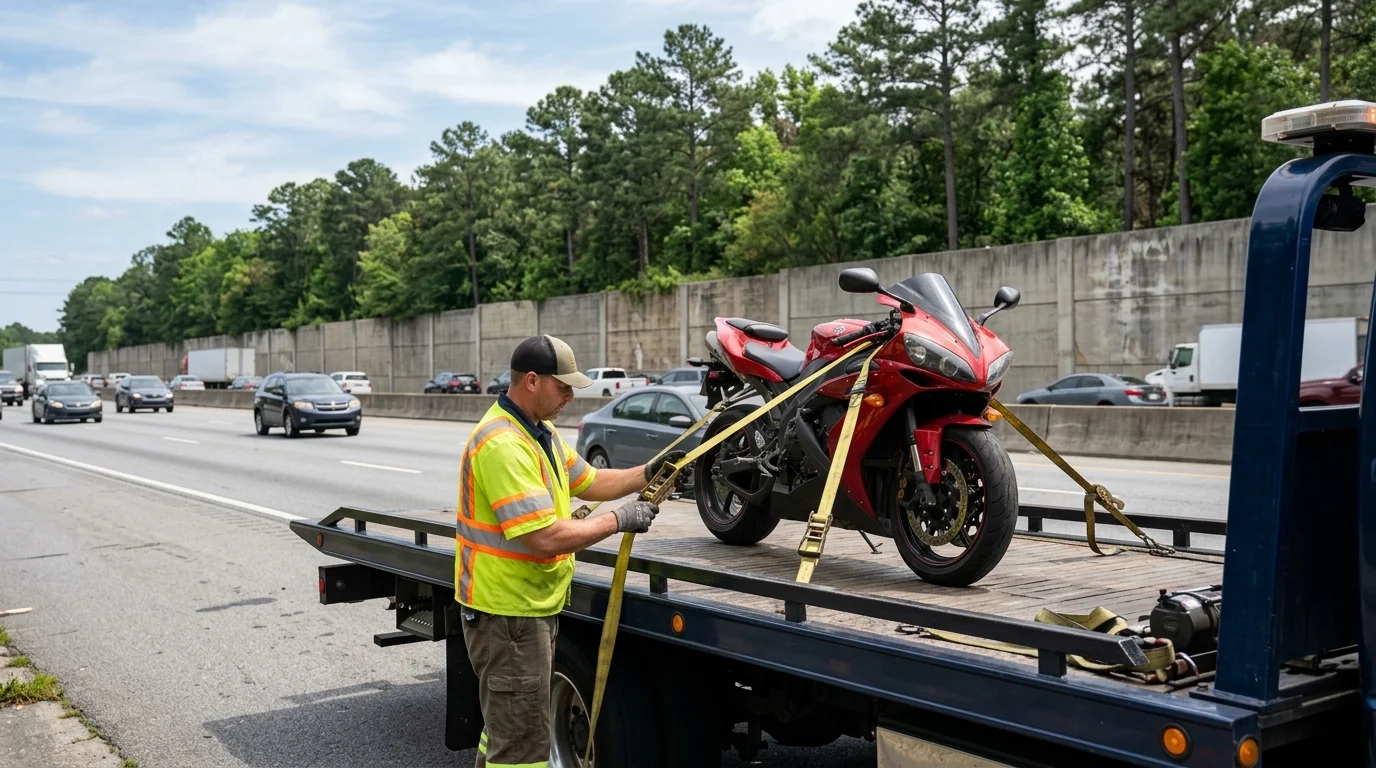
Why most Atlanta motorcycle tows should go on a flatbed
A motorcycle has two contact patches and a high center of gravity. It does not sit on four corners the way a Civic does. On a flatbed, the whole bike rides on diamond plate. The wheels stay on a solid surface. Soft loops and chocks hold the lean. The operator we send can walk around the bike, see the fairing, and pick strap points that will not crush plastic.
That is the usual ask for North Fulton weekend ride traffic on GA-400, for Perimeter loops on I-285, and for a dead bike in a Midtown garage. Sportbikes with low fairings. Bagged touring bikes. Harleys with highway bars. Scooters with plastic bodies that scratch if they kiss steel. A trike or a sidecar rig still wants a wide, level deck more often than a lift that only grabs one end.
Yes, a tow operator can move a motorcycle. That is a real search, and the short answer is yes. The longer answer is that not every wrecker already sitting on the Downtown Connector is set up for a two-wheeler. Some trucks on the Perimeter are wheel-lift units meant for cars. Some are medium-duty beds with no chock. When you call, say it is a motorcycle and ask for a flatbed with bike straps. We match that request with an independent licensed operator. We do not own the trucks. The operator on the job does the loading.
This is also not motorcycle shipping. Door-to-door enclosed hauls out of the metro, multi-day lanes to another state, terminal drop-offs: those are a different trade. A local tow is the call when the bike will not roll from a shoulder, a lot, or a shop. If you bought a used bike in Marietta and cannot ride it home to Decatur, that can still be a consensual local move. The price is quoted before dispatch. There is no published average we can stand behind for that quote in this metro, and anyone selling you a single “typical” number is guessing. For how those quotes usually get built on four wheels, and how that thinking carries over, read what a tow costs in Atlanta.
A friend’s pickup looks simple. The tailgate is often too high. The bed is often too short for a stretched cruiser. A ratchet strap across a fork tube can crush a stanchion. If the bike will not ride, wait for a deck built for it.
Wheel-lift risks on a two-wheeler
A wheel-lift is a light-duty boom that scoops one axle and lets the other end trail. On a car it is common. On a motorcycle it is a compromise. The bike has to stay upright while one wheel is in the air. There is no second axle to share the load. Forks, swingarms, and aftermarket pegs were not designed to hang from a boom on I-285 at speed.
Operators still use a wheel-lift on two-wheelers in some spots. A tight Cobb office garage, a low-clearance deck in Buckhead, a service alley off the Connector where a 21-foot bed will not square up: the operator on scene may say the lift is the only way out. That is their call. Do not treat it as the default. Ask for the flatbed. If the truck that arrives cannot get in, the operator can say so and reset.
The damage pattern is predictable. A strap on a painted tank. A boom pad on a lower fairing. A hanging rear wheel that lets the bike pendulum when a MARTA bus goes by. A front-end lift that loads the forks the wrong way. Clip-ons and bar-end mirrors take the hit first on a sportbike. Floorboards and bags take it on a touring bike. A scooter’s apron is all plastic. None of that is a reason to panic. It is a reason to talk before the boom comes down.
People hunt for the cheapest way to move a bike. A wheel-lift can look cheaper than a bed because the truck is lighter and already nearby. A friend’s pickup can look free. The cheaper method is the one that does not drop the bike or fold a fork. On a consensual roadside call there is no statutory rate cap. The operator sets the price and quotes it before dispatch. City of Atlanta police-impound caps and the Georgia DPS private-property tariff are different jobs, with different rules. They do not set what you pay when you called for help on GA-400.
If a wheel-lift is what fits the space, stay on the bike’s uphill side while it is being lifted, keep your feet clear of the boom, and watch the contact points. If you see a strap landing on a brake line or a carbon front fender, say so before the winch takes weight.
Breakdowns versus crash recovery on GA-400 and I-285
A dead bike and a crashed bike are not the same call. A breakdown is a bike that still has geometry. Flat on the Alpharetta collector lanes. Battery that will not crank in a Johns Creek shopping lot after a Sunday ride. Chain that came off on the I-575 run up toward Cherokee. The operator we send can usually roll or winch it onto the bed, chock it, and strap it. You still want the bike off the travel lane first. GDOT HERO patrols the metro freeways, can push a stranded vehicle out of the live lanes, and does not tow a motorcycle to a shop. If HERO is already there, stay with them until the wrecker is set.
Crash recovery is slower and uglier. Fairings in pieces on the I-285 shoulder near Spaghetti Junction. A slider that dug into the sound wall. Forks bent back. A bike on its side in the Brookwood split grass. Fluids on the deck. The operator may need a winch, a board, and extra hands. Hard parts that already broke should be bagged so they ride with the bike, not left for the next car. If the bike will not roll, it gets dragged onto the bed on a mat or in a cradle, never scraped down the diamond plate on painted plastic. For a scene that also involves other vehicles, accident recovery is the right service family. Motorcycle towing is still the handling method once the bike is ready to leave.
Weekend texture matters here. North Fulton on a clear Saturday puts more sportbikes on GA-400 than a wet Tuesday. The Perimeter fills with group rides heading toward the mountains. After a Braves game, Truist Park lots tow leftover cars; a bike left in a Battery deck past the posted window can get caught in that sweep. Mercedes-Benz Stadium and State Farm Arena lots close after events and tow at the owner’s expense. Hartsfield-Jackson’s shoulder and ramp parking is a separate mess, with airport fines plus a tow. If you are waiting on a pickup at ATL, use the free Park & Wait lot at 1920 Autoport Dr in College Park rather than sitting on a ramp. Details live on Hartsfield-Jackson parking.
A search for a tow truck near me in Atlanta on a phone, on a shoulder, is how a lot of these calls start. Tell the line which road, which direction, and the last exit you passed. GA-400 north of the Perimeter is not the same dispatch as the Grady Curve. I-285 east at Memorial is not Roswell Road in Sandy Springs. Name the mile marker if you can see it.
What the 12-second rule is, and is not
Riders ask about a 12-second rule. In rider training it is usually a scanning habit: look far enough down the road that you have about twelve seconds of path in view. It is not a Georgia towing statute. It is not a wrecker timing standard. I could not confirm any O.C.G.A. section, DPS tariff line, or City of Atlanta code that uses that name for motorcycle tows. Do not wait twelve seconds to get off a live lane. Get the bike and your body behind a barrier, then call.
What to tell dispatch: lean, fairing, aftermarket pegs
The first minute on the line decides which truck rolls. “I need a tow” is not enough. “I have a 600 on GA-400 north, past Northridge, bike is upright, right fairing is cracked, aftermarket rearsets” is enough. We take that and match you with an independent operator who can handle it. The line takes calls 24 hours a day, in English and Spanish.
Say the bike type. Sportbike, Harley, bagger, dual-sport, scooter, trike. A tall adventure bike with crash bars loads differently from a slammed streetfighter. A 50cc scooter on Buford Highway in Doraville is a different strap job from a loaded Gold Wing in Milton.
Say whether it stands on its own. Side stand still works, or it is on the kickstand with a broken foot. On its side in the grass. Against a sound wall. In a parking deck with a two-inch lip. Lean angle matters because the operator plans the winch line from that.
Say what is fragile. Full fairing. Belly pan already sitting on the asphalt. Aftermarket clip-ons. Carbon wheels. Extended bags. Highway pegs that stick out farther than the stock ones. A rearset that moved the peg into the strap path. Soft luggage you can pull off before the truck arrives. A GoPro mount, a phone cradle, a windshield bag: take those off so they do not become projectiles.
Say the access. Shoulder of I-285 with a guardrail. Peach Pass lane, which a wrecker may not be able to enter the way a regular lane can. Garage with a height bar. Gated apartment lot in Gwinnett. A side street in Chamblee off Buford Highway. If a gate code is required, have it ready. If the bike is in a police scene, say that. A consensual roadside call, a city impound, and a private-lot tow are three different jobs in this metro. Do not mix them. If you called us, it is a consensual move and the operator quotes before dispatch.
Center stand or no center stand. Stock exhaust or a low aftermarket can that will hit the ramp. A steering lock you can release. A disc lock still on the front rotor. A rear wheel that will not turn because the chain is jammed. All of that changes how the bike goes up the ramp.
How the operator we send straps the bike, and what you should watch
Stay where you can see the bike. You know the plastic. The operator knows the truck. Together that is the whole job.
A typical load on a flatbed looks like this. The bed tilts and the ramp meets the pavement. A wheel chock or a block sits on the deck for the front tire. Soft loops, not hard hooks, go around the lower triple or the fork lowers, never around a brake line, a throttle cable, or a hollow clip-on. Rear straps go to the swingarm or to a solid peg mount, not to an exhaust can and not to a plastic cowling screw. The operator cinches until the suspension sags a little. The bike should feel planted, not cranked over so hard the forks bottom. A second pair of straps often ties the rear so the bike cannot walk.
Watch for four things. Straps on painted bodywork. A loop sitting on a brake hose. A rear strap pulling against a license-plate hanger. A front chock that lets the wheel climb out when the truck brakes on the Connector. If you see any of those, speak up before the bed goes back to level. Once the deck is flat, walk around once more. Fairing tips, a hanging kickstand, a bag that shifted.
Soft loops and wheel chocks are the usual hardware. Some operators carry a motorcycle-specific stand. Some use a rubber mat so a lowered bike does not grind a belly pan. None of that is a promise about a particular truck. It is what you should look for, and what you should ask about if you do not see it.
You can ride in the wrecker’s cab if the operator says there is a seat and it is allowed on that truck. Do not stand on the deck while the truck is moving. Do not sit on the bike once it is strapped. If you have a helmet bag, a backpack, and a disk lock, take them with you. Georgia’s abandoned-vehicle clock is a different problem, for bikes left at shops or lots for 30 days. This page is about the load, not that statute.
At the shop, watch the unload the same way. The dangerous moment is the last two feet of ramp, when the front wheel comes off the chock and the bike is light. Keep bystanders off that side. Once the bike is on its stand, do a slow walk-around in the light: fork seals, bar ends, the side that was down, the strap contact points. Note anything new before the operator leaves. That is for your records, not a review and not a warranty. We do not publish ratings, and we do not guarantee the work. The operator who loaded the bike is the one who did the work.
When to call us
Once the bike will not roll under its own power, or the GA-400 shoulder is too tight to wait on a friend’s pickup, this is a dispatch job. The line takes calls 24 hours a day, in English and Spanish. After a recording notice, the call is recorded, and we match you with an independent local operator. Call us at (678) 379-5984.