The first freeze in Atlanta starts on an overpass. Thin ice on an I-285 rail, a sedan cocked on the shoulder, and the Perimeter still rolling while your tires will not bite. That is ice towing Atlanta, and it is a recovery on glazed pavement, not a dry Tuesday shop drop-off.
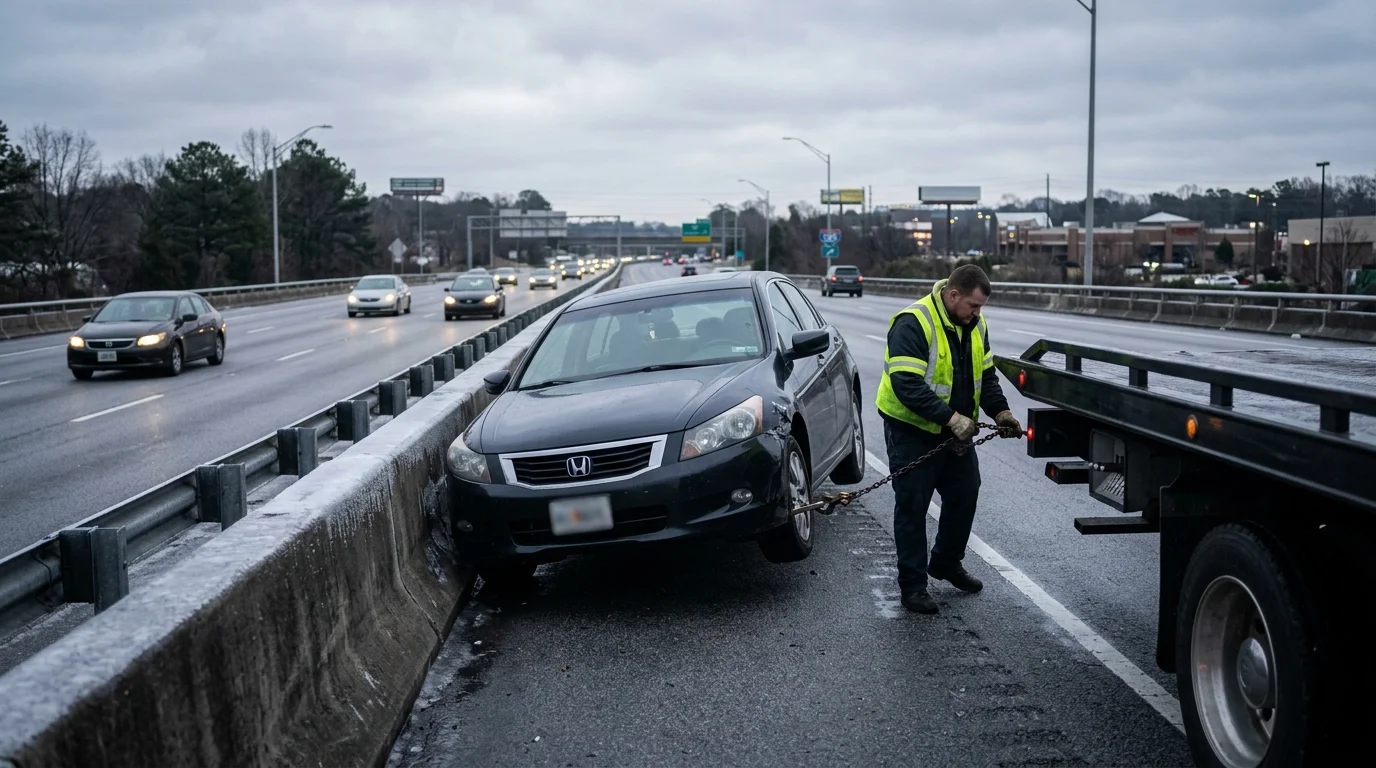
Bridges, ramps, and the Perimeter glaze first
Atlanta ice does not coat every lane the same way. Bridges, ramps, and elevated decks lose heat first. The 64-mile I-285 loop, the Downtown Connector (I-75/85), GA-400, and the Tom Moreland Interchange at Spaghetti Junction glaze while surface streets in Decatur or Marietta still look wet. The Brookwood split, Peach Pass express lanes, and the ramps off I-20, I-75, I-575, and I-675 fail in the same order. If a freeze is in the forecast, those are the spots that go first.
January 28, 2014 is the local memory for this. About 2.5 inches of snow, hundreds of abandoned cars, and National Guard Humvees on metro roads. People still call it Snowmageddon. The lesson was not that Atlanta gets a northern winter. The lesson was that a light glaze on the Perimeter can stall the whole region, because the Connector already carries 400,000-plus vehicles a day.
Black ice here is usually a film, not a drift. It hides on the shaded side of an overpass, on the painted gore at a ramp, and on the steel joints of a flyover. A car that was fine on Buford Highway (GA-13) can lose both ends the moment it climbs onto I-285. North Fulton on GA-400 and the Hartsfield airport corridor do not ice on the same clock. The Perimeter is higher, faster, and more exposed.
Whether ice is on Atlanta pavement tonight is a live traffic and weather question. This page cannot confirm current glaze. Check GDOT HERO and the National Weather Service before you roll. HERO units patrol metro freeways, clear hazards, and help stranded drivers. They do not tow a vehicle to a shop.
If you are already on the shoulder, treat the next vehicle as if it cannot stop. Keep seat belts on. Keep the wheels pointed with traffic. Do not stand in a travel lane to “flag” anyone. Ice towing Atlanta is a highway recovery on a glazed deck, and the operator we send works that scene, not a parking-lot pull.
Stay with the car or leave it on I-285 and the Connector
If you can get fully onto the shoulder, turn on the hazards and stay with the car if it is safe. A running heater, a charged phone, and a visible vehicle beat a walk along the Perimeter in a freeze. Leaving a car in a travel lane on I-285 or the Connector turns a stall into a crash scene for the next driver who cannot stop.
Do not park on a gore, a ramp nose, or under a flyover just because the ice started there. Those are the spots other cars lose traction. If you can creep forward onto a true shoulder without crossing live lanes, do that. If you cannot, stay buckled, keep the hazards on, and call. Walking the inner loop at night in a glaze is how people get hit.
A note on the windshield is not a call to police. If you walk away and leave the car in a lane, on a ramp, or blocking a shoulder that first responders need, an officer can treat it as a hazard and order a wrecker. That is no longer a roadside call you control. It becomes a police or city impound, with a different lot, a different fee schedule, and a different release. O.C.G.A. § 40-6-203 covers stopping, standing, and parking restrictions. Confirm current enforcement with the agency that stopped you. A specific ice-abandonment fine for this metro could not be confirmed here.
If you must leave the car, say so on the call so the operator we send is not hunting an empty scene. Tell dispatch the mile marker, the direction, and the nearest named interchange. Inner loop versus outer loop on I-285 matters. So does northbound versus southbound on the Connector, and whether you are before or after Spaghetti Junction. Then get yourself to a safe place. Do not climb a glazed barrier. Do not cross live lanes on foot.
HERO may stop, set cones, and wait with you. That help is real. It is still not a tow to a shop in Marietta, a yard in Tucker, or a driveway in Gwinnett. If the car has to move off the freeway, that is a consensual recovery you request, or a police-ordered tow you did not request. Those two paths do not pay the same, and they do not end at the same window.
Winch-out versus a full tow on iced pavement
A winch-out is for a car that is intact, reachable, and close to a travelable surface. Think a slide into the grass at a GA-400 ramp, a spin that stopped short of the wall on I-285, or a nose in the ditch at a Connector crossover. The operator we send sets a line, pulls the car back to pavement, and you drive off if the car will still roll and steer.
A full tow is for everything else. Bent wheel, airbags, leaking fluid, a car high-centered on a glazed curb, or a vehicle that will not stay in gear on ice. On iced pavement the wrecker has the same traction problem you do. The operator we send may wait for a better angle, use a flatbed, or ask police for a lane closure before anyone hooks a line. That is accident recovery, not a parking-lot pull.
Do not try to yank the car with a strap from a friend’s truck. On ice, the second vehicle slides into the first, or both of you end up in the gore. Do not idle in a travel lane while someone “just tugs it.” The operator we dispatch runs the recovery. Quick Tow Atlanta is a referral line. We do not own wreckers, we do not run a yard, and we do not stand in the lane with a snatch strap.
Tell dispatch what you can see. Which wheels are off the pavement. Whether the car is on its wheels. Whether it is against a wall, a rail, or a tree in the infield. Whether traffic is still using the lane beside you. A winch-out on a quiet shoulder is one job. A recovery in the left lane of I-285 at the Brookwood split is another. The operator quotes before dispatch. There is no published per-mile ice surcharge in the claims we can make, and we will not invent one.
If the scene is a crash, stay in the car if it is safer there, and say so on the call. Ice plus impact is still a wreck scene. The operator we send coordinates with whatever unit is already there. For a car that will not roll, ask for a tow truck near you in Atlanta as an emergency recovery, not as a jump start with a rope. A dead 12-volt that still drives after a pack jump is jump start in Atlanta.
What dispatch needs from you on an ice call
Location first, then the car, then the people. On I-285, inner loop or outer loop, and the nearest interchange you can name. On the Connector, northbound or southbound, and whether you are downtown, at the Grady Curve, or already at the Brookwood split. On GA-400, the nearest exit. At Spaghetti Junction, say so. “Somewhere on the Perimeter” is not a pin.
Give the mile marker if you can see it. Give a nearby landmark if you cannot: a MARTA station, a named bridge, a mall, a hospital. Say which shoulder you are on. Say if you are in a travel lane. Say if cones, HERO, or police are already there. Ice cuts visibility. The operator we send is driving the same glaze you are.
Then the vehicle. Make, color, and last four of the plate if you have it. Whether it still rolls. Whether it is leaking. Whether the wheels are straight. Occupants, including kids and pets. Fuel in the tank, because a long wait on the shoulder in a freeze is a different problem than a five-minute hook. If anyone is hurt, that is 911 first. The tow line is not EMS.
The price is quoted before dispatch. The operator sets it. We do not publish a brand rate, a flat ice fee, or a promised arrival. For how Atlanta towing prices are quoted, and how city, county, and state caps apply only to the jobs they actually cover, read tow cost in Atlanta. A consensual roadside call on iced I-285 is not the City of Atlanta police-tow cap, and it is not the Georgia DPS private-property ceiling.
The line takes calls 24/7 in English and Spanish. Calls are recorded after a notice. Georgia is a one-party consent state. You get an independent local operator, not a truck we own. Have the phone on, the hazards on, and a description that a driver who has never seen your car can use in fog.
How a storm tow differs from a police impound
There are three towing situations in this metro, and ice does not merge them. A police or city impound is when law enforcement orders the wrecker. A non-consensual private-property tow is an apartment, retail, or HOA lot under O.C.G.A. § 44-1-13. A consensual roadside call is the one you ask for. Ice on I-285 is almost always the first or the third. It is almost never an HOA lot.
If you called us, you are in a consensual job. The operator we send quotes before dispatch. There is no statutory rate cap on that call in the claims we can make. Atlanta Code § 162-227 does not apply to a roadside request you placed. That code caps a City of Atlanta police tow at $125, with no storage for the first 24 hours, paid by cash, check, debit, or major credit card at no surcharge. It is the city wrecker assigned by police zone. We do not name those contractors, because a current public list could not be confirmed for publication.
If you left the car and an officer ordered it moved, you are in an impound. City of Atlanta, Fulton, and DeKalb each run their own process. DeKalb’s lot is at 2158 Tucker Industrial Rd, Tucker, GA 30084, at $125 to impound plus $15 per day of storage. Fulton County releases from the Marshal admin office at 185 Central Ave SW, 9th Floor, Atlanta 30303, not from the tow yard. Hours there are Monday through Friday, 8:30 a.m. to 5:00 p.m. Cobb, Gwinnett, Clayton, and the outer ring set their own process. No administrative fee for those counties is published here, so we will not invent one.
A private-property tow is a different statute and a different ceiling. For a vehicle 10,000 lbs GVWR or under, Georgia DPS Maximum Rate Tariff No. 5 caps the tow at $228, daily storage at $33, no storage for the first 24 hours, and notification charges at $91. Those are ceilings, not a brand price, and they do not apply because you iced on the Perimeter.
If you do not know which of the three you are in, start with who ordered the truck. You did, an officer did, or a property manager did. That answer decides the lot, the cap, and the window. A storm does not convert a consensual call into a $125 city tow, and it does not convert a police tow into a quoted roadside job.
When to call us
When the car will not move off an iced shoulder on I-285, the Connector, GA-400, or a glazed ramp, this is no longer a wait-it-out job. Call us at (678) 379-5984. The line is answered 24 hours a day, calls are recorded after a notice, and an independent local operator is dispatched for emergency towing.